
US company formation guide · About an hour of forms, plus the time your state takes to process the filing · State filing fees from $40
Form the company and open a business bank account
A checklist for US founders: form an LLC in your home state, get the free EIN from the IRS, open a business checking account, and put the yearly filings on a calendar. With the two cases where an LLC is the wrong start.
Last verified against the official US company formation documentation on October 11, 2026. Prices and free tiers change, so open the linked pages before you rely on a number.
Working with a coding agent? Get the agent file for this guide. It covers the same setup as exact steps an agent can follow.
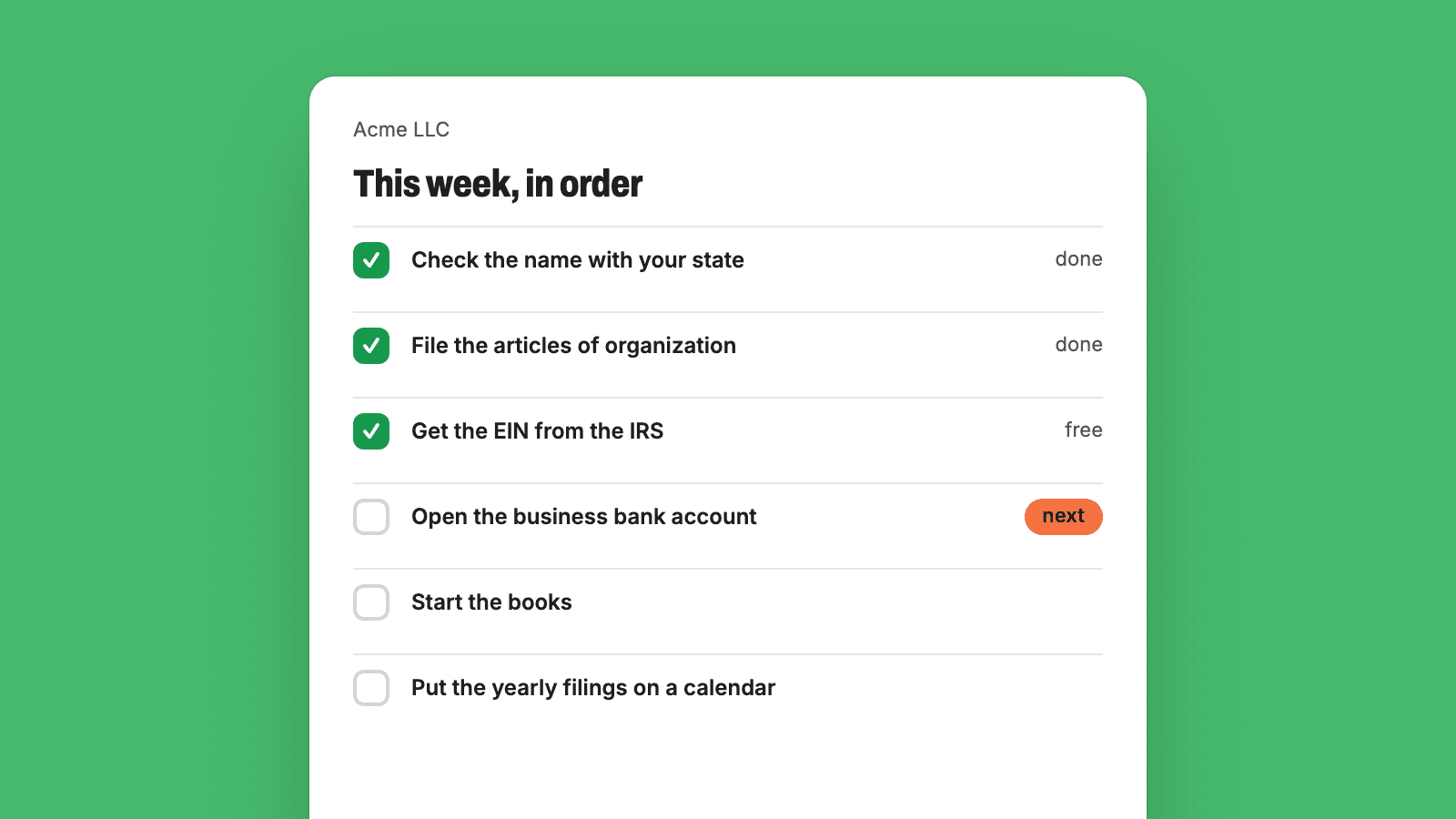
Here is the decision, already made. For most first-time founders in the United States: form an LLC in the state you live and work in, get the free EIN from the IRS, open a business checking account, and get back to building. You can do most of it this week.
Founders lose months to this choice. A plain LLC that exists beats a perfect structure you never file. The Stripe Atlas guide to LLCs and C corporations, written with the law firm Orrick, says LLCs are chosen by many founders of side projects, small teams and bootstrapped businesses, and by businesses that do not yet know what they will become. The SBA says the total cost to register a business is less than $300 in most cases.
This is general information for US founders. It is not legal or tax advice.
The two cases where the default is wrong
- You are raising venture money or granting equity soon. Form a Delaware C corporation, and pay a startup lawyer to do it. The Stripe Atlas guide says professional investors overwhelmingly prefer C corporations, that many of them will ask an LLC to convert to a Delaware C corporation before they invest, and that C corporations have well-understood mechanics for giving employees equity. The SBA also lists corporations as a good choice for businesses that need to raise money. If an accelerator is your plan, check its terms first: Y Combinator's deal page says it invests in corporations and tells founders who have not incorporated yet not to worry about it, because it helps them do that once they are accepted.
- You have co-founders. An LLC is still fine, but the ownership has to be written down properly. The Stripe Atlas guide describes an LLC's operating agreement as the contract between the owners that says how the company is run and how the returns are split. With two or more owners, pay a lawyer to write that one document.
If neither is you, start with the LLC. It can change later. The same Stripe Atlas guide notes that Facebook started as an LLC and converted to a C corporation. The SBA says you may convert to a different structure in the future, and that a conversion can have tax consequences, so do it with a lawyer and an accountant when the day comes.
Waiting has a cost too. Until you register, the SBA says you are automatically a sole proprietorship, where your business and personal assets are not separate and you can be held personally liable for the debts of the business. Your business money sits in your personal account, and every contract you sign, you sign as yourself.
What it costs
One filing fee to the state, then a small yearly filing in most states. These figures come from each state's own pages at the time of writing:
- Kentucky: $40 to file articles of organization. The annual report is $15, due by June 30.
- Colorado: $50 to file online. The periodic report is $25 each year.
- California: $70 to file, plus a $20 Statement of Information within 90 days and every two years after. The large cost is yearly: the Franchise Tax Board charges every LLC an annual tax of $800, due even if the LLC does no business.
- Delaware: $110 to form an LLC (fee schedule revised August 1, 2026), and a $400 annual tax due by June 1.
Delaware is on the list to show why your home state is the default for an LLC. The SBA says a company that is formed in one state and active in another typically pays taxes and annual report fees in both. The EIN is free everywhere.
Before you start
Fill in this record first. These are the answers the state form and the IRS application ask for. The layout is ours.
# What to have ready. Fill this in once and every form below goes quickly.
# Keep it out of any repository, and never write a Social Security number in it.
LEGAL_NAME=""           # exactly as you will file it, ending in LLC
STATE=""                # the state you live and work in
BUSINESS_ADDRESS=""     # the address the state form asks for
REGISTERED_AGENT=""     # you, at a street address in that state, or a service
MEMBERS=""              # each owner and the share each one holds
RESPONSIBLE_PARTY=""    # the one person named on the EIN application. Name only
The checklist
1. Check the name with your state
Search your state's business database for the name you want. The SBA says most states will not register a name that someone else has already registered. Its state lookup links to the right agency in every state. Our guide to choosing a name and buying the domain covers the other name checks.
2. Pick a registered agent
This is the person or company that receives legal papers for the LLC. The SBA says you need one before you file, located in the state where you register. In your home state that can usually be you, which costs nothing. California's Secretary of State, for example, says the agent can be an individual who resides in California, and Delaware lets a business that is physically located in Delaware act as its own registered agent. The trade-off, from the same California page: the agent's name and street address are a public record. If you would rather keep your home address off it, pay a registered agent service.
3. File the articles of organization
File on your Secretary of State's website, and pay the fee from the list above. The SBA describes the articles as a simple document with the company name, address, member names and registered agent. Save the filed copy the state returns. Then check whether your state wants a first report soon after. The SBA says these are most often due within 30 to 90 days.
4. Get the EIN at irs.gov
The EIN is the company's federal tax number. Apply on the IRS's own EIN page, after the state has approved your filing. It is free, and the IRS issues the number immediately online when the application is approved. You need the Social Security number or taxpayer ID of the one person responsible for the company, and you have to finish in one session. Print the confirmation letter at the end. The IRS says you never have to pay a fee for an EIN, so close any site that asks for one.
5. Write a simple operating agreement
The SBA says it is widely recommended to create one even if your state does not require it. For a one-owner LLC, a few pages are enough: who owns the company, who makes decisions, and how money goes in and comes out. Sign it and keep it with the articles. The bank may ask for it.
6. Open the business bank account
The SBA says you can open a business bank account once you have the EIN, and lists what banks commonly ask for. Banks also have to identify every person who owns 25 percent or more of the company and one person who controls it, so bring your ID.
# Bank packet. Have each item ready before you start an application. Some banks ask for more.
EIN_LETTER=""             # the confirmation letter you printed at the end of the IRS application
ARTICLES=""               # the filed articles of organization, as the state returned them
OPERATING_AGREEMENT=""    # signed by every member
BUSINESS_LICENSE=""       # only if your state, county or city issued one
OWNERS_25_PERCENT=""      # every person who owns 25 percent or more. The bank verifies each one's identity
CONTROL_PERSON=""         # one person who controls the company. The bank verifies their identity too
Choose an FDIC-insured bank. The FDIC insures deposits to at least $250,000 per depositor at each insured bank, and warns that nonbank companies are never FDIC-insured themselves, even when they work with a bank that is. Do not spend a week comparing accounts. A checking account with no monthly fee at a bank you can reach is enough to start.
7. Turn on bookkeeping from the first transaction
Every business dollar goes through the business account, and nothing personal does. The IRS says in Publication 583 to keep the business account separate from your personal one, and that you may choose any recordkeeping system that clearly shows your income and expenses. Connect the account to bookkeeping software or a spreadsheet on day one, keep every receipt, and look at it once a month.
8. Put the yearly filings on a calendar
The SBA says most states require an annual report or a biennial statement, and some charge a franchise tax. Find your state's dates on its own site and put them in your calendar today. Colorado says it plainly: you are responsible for filing on time whether you receive a reminder or not. For federal tax, the IRS says a one-owner LLC is generally reported on Schedule C of your own Form 1040, and that individuals generally make estimated tax payments if they expect to owe $1,000 or more.
# Yearly calendar. Read each date and fee from your own state's page, then add it
# to your calendar as a repeating event with a reminder two weeks ahead.
STATE_REPORT=""           # annual or biennial report: due date and fee
STATE_TAX=""              # annual or franchise tax, if your state charges one: due date and amount
FEDERAL_RETURN=""         # the date your own income tax return is due. A one-owner LLC is reported there
ESTIMATED_TAX=""          # the payment dates, if you expect to owe 1,000 dollars or more
LICENSE_RENEWALS=""       # each state, county or city license and its renewal date
AGENT_RENEWAL=""          # only if you pay a registered agent service
9. Check for a local license or sales tax registration
The SBA says requirements vary with your activities and location, and points you to your Secretary of State's site and your city or county. If you sell physical goods, look up your state's sales tax registration. In California that is a seller's permit, and registering online is free. The IRS keeps a list of every state's government websites.
One filing you can cross off
You may read that every new company has to report its owners to FinCEN. FinCEN's beneficial ownership page says that under its final rule, effective August 14, 2026, companies formed in the United States are exempt and no longer file those reports.
When to pay a professional
- A lawyer when you are raising money from investors, giving anyone equity, or forming with a co-founder.
- A lawyer and an accountant when you convert the LLC to a corporation.
- An accountant for your first business tax return, and before you hire your first employee.
- Either one when you have staff, an office or most of your customers in a second state, or when a form asks something you do not understand.
Free help exists too. The SBA and its partners, including SCORE and the Small Business Development Centers, offer free or low-cost counseling near you.
Hand this to your agent
This guide is also written out for a coding agent, as one Markdown file. It has the checks to run in your repository first, each step with its commands and code, the environment variables by name, a check after every step, and the points where the agent has to stop and ask you. Get the agent file and give your agent the file or its address.
The agent builds your state-specific checklist from the official pages and tracks the deadlines. Every filing, payment, signature and legal or tax choice stays with you: the file tells the agent to stop and ask each time.
Sources
- Launch your business, U.S. Small Business Administration
- State registration lookup, U.S. Small Business Administration
- Manage your business, U.S. Small Business Administration
- Local assistance, U.S. Small Business Administration
- Get an employer identification number, Internal Revenue Service
- Single member limited liability companies, Internal Revenue Service
- Estimated taxes, Internal Revenue Service
- Publication 583, Starting a Business and Keeping Records, Internal Revenue Service
- Recordkeeping, Internal Revenue Service
- State government websites, Internal Revenue Service
- Beneficial Ownership Information Reporting, Financial Crimes Enforcement Network
- Customer Due Diligence (CDD) Final Rule, Financial Crimes Enforcement Network
- Understanding deposit insurance, Federal Deposit Insurance Corporation
- Banking with third-party apps, Federal Deposit Insurance Corporation
- Business filings fees, Kentucky Secretary of State
- Annual reports, Kentucky Secretary of State
- Business organizations fee schedule, Colorado Secretary of State
- Periodic reports FAQs, Colorado Secretary of State
- Forms and fees: limited liability companies, California (domestic), California Secretary of State
- Frequently asked questions, California Secretary of State
- Limited liability company, California Franchise Tax Board
- Permits and licenses, California Department of Tax and Fee Administration
- Corporate fee schedule, Delaware Division of Corporations
- Pay LLC, LP and GP taxes, Delaware Division of Corporations
- How to form a new business entity, Delaware Division of Corporations
- LLC vs. C corporation: what's the difference?, Stripe Atlas guide written with Orrick (not a government source)
- The Y Combinator standard deal, Y Combinator (not a government source)
Want this already wired together?
We are packaging this stack into production kits. They are not available yet. If you would rather have us build it with you now, book a call.